
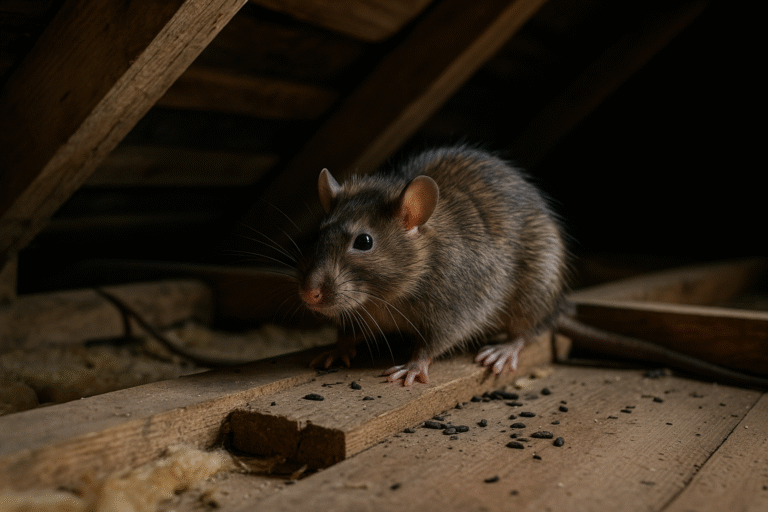
Rats in the attic can pose a serious challenge for both residential and commercial property owners. It's important to act quickly to minimise damage and health risks. Identifying the sounds of rats in the attic is an essential part of early detection and effective control.
Rats in the attic can often be identified by a number of characteristic sounds. These include rattling, scratching, squeaking, gnawing and stomping noises. The sounds vary depending on the material of the ceiling; for example, wooden ceilings can amplify the rattling and gnawing, while concrete ceilings can make the sounds more muffled. Rats are nocturnal animals, which means the sounds are often most audible at night when they are hunting for food or building nests.
It can be challenging to distinguish between the sounds of rats and mice, but there are some differences. Rats typically make louder and more frequent sounds than mice as they are larger and more active. Mice often move more cautiously and can be harder to hear. The timing of activity can also give a clue; while both rats and mice are most active at night, rats' movements can be more pronounced. Other animals such as pigeons or martens can also be mistaken for rats, but their sounds will typically be different in both pattern and intensity.
In addition to the characteristic sounds that rats make, their presence in the attic can also be identified through a number of other signs. Droppings are often the most visible evidence and can be found in areas where rats frequent. These small, dark faeces are typically cylindrical and can vary in size depending on the rat species. Traces of gnawing damage are also common as rats constantly have to wear down their teeth. This can result in damaged wiring, woodwork and insulation materials.
Another indicator can be the characteristic odour of ammonia emanating from rat urine. This odour can be particularly pervasive in enclosed spaces like the attic and can be a clear sign of a larger rat population. Another odour that can occur is the unpleasant stench of dead rats that can become trapped in walls or under floorboards. These odours are often one of the first things residents notice when rats are present.
Rats can cause significant damage to an attic structure, which can have serious consequences for building integrity and safety. Their constant gnawing can damage insulation materials, reducing their effectiveness and can lead to increased energy bills. Damage to insulation can also create cold bridges where heat escapes, further affecting the building's energy consumption.
Electrical installations are also at risk as rats tend to gnaw on wires. This can lead to short circuits and, in the worst case, a fire hazard. Damage to wooden beams and other load-bearing elements can also weaken the ceiling structure, which may require extensive repairs. It is therefore crucial to act quickly if you suspect the presence of rats to avoid extensive and costly damage.
If you suspect rats in your attic, it is crucial to act quickly to minimise damage and health risks. First and foremost, a thorough inspection should be carried out to confirm the presence of rats. This involves looking for both sounds and physical signs such as droppings, gnawing damage and odours. It's important to avoid disturbing the area unnecessarily as this can cause the rats to spread to other parts of the building.
Professional help is often needed to effectively deal with a rat situation. Our team can perform a detailed inspection and use specialised equipment to assess the extent of the problem. This includes using cameras and listening devices to pinpoint the exact location and movement patterns of rats. By understanding how the rats have gained access to the attic, we can propose customised solutions to prevent further intrusion.
Prevention is the key to avoiding future problems with rats in the attic. One of the first steps is to ensure that all potential entry points are sealed. This can include sealing cracks and openings in walls, roof and foundation. It's also important to ensure that vents and chimneys are properly covered with metal mesh to prevent rats from entering.
Regular property maintenance can also play a significant role in prevention. This includes keeping the attic clean and free of food sources that can attract rats. Removing clutter and unnecessary storage items can also reduce hiding places for rats. Additionally, it can be beneficial to prune trees and shrubs that are close to the house as these can act as bridges for rats to access the attic.
Rattech udfører professionel rottebekæmpelse og forebyggelse med særlig fokus på erhvervsejendomme, hvor driftssikkerhed og kontinuitet er afgørende. Processen starter altid med en omfattende inspektion, der har til formål at kortlægge problemets omfang samt identificere de adgangspunkter og installationsfejl, som rotter typisk udnytter. Her anvendes avanceret teknologi som termiske kameraer og akustisk måleudstyr, hvilket gør det muligt at opdage skjult aktivitet og vurdere risikoen præcist.
På baggrund af inspektionen udarbejdes en målrettet handlingsplan med både akutte tiltag og langsigtede løsninger. Dette kan omfatte opsætning af fælder, forbedring af bygningsmæssige forhold og andre metoder, der effektivt håndterer den aktuelle aktivitet og reducerer risikoen for nye indtrængninger. Målet er at skabe stabile rammer for virksomheden, hvor skadedyrsrisici håndteres proaktivt.
Rattech tilbyder desuden rådgivning om forebyggende løsninger, som virksomheder kan implementere for at sikre ejendommen mod fremtidige udfordringer. Dette kan være alt fra optimering af affaldshåndtering til strukturelle forbedringer i bygninger og udearealer.
Rats in the attic can be identified by sounds such as rattling, scratching and squeaking, often most audible at night.
Rat noises are typically heard at night, as rats are most active in the dark.
In addition to sounds, signs such as droppings, gnawing damage and a characteristic odour can indicate the presence of rats.
It is recommended to contact professionals for inspection and control, and to take quick action to minimise damage.